Image Credit
Rose Bowl
A Guide to the Rose Bowl
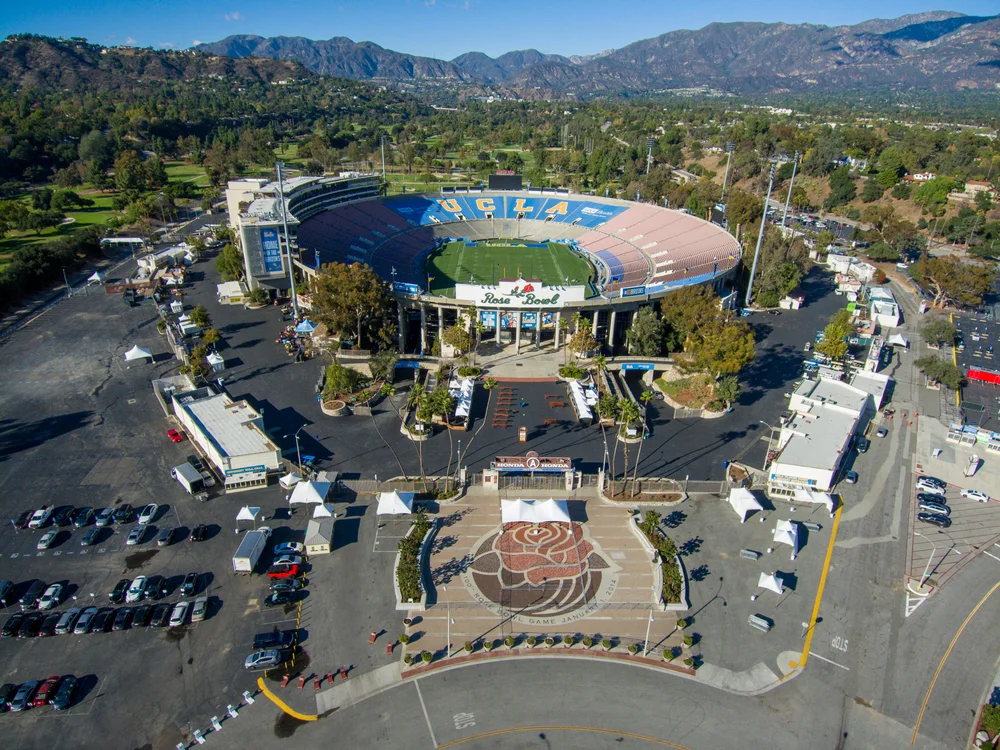
The Rose Bowl is both UCLA football’s home and a national monument to the sport. Opened in 1922 in Pasadena’s Arroyo Seco, the vast historic bowl sits beneath the San Gabriel Mountains amid a golf course, mature trees and residential hills. Golf-course tailgating, BruinFest and the pilgrimage-like approach give every Bruins game a sense of occasion, even in UCLA’s smaller tenant configuration.
Getting to the Rose Bowl
The stadium lies below Old Pasadena in a natural traffic basin. Linda Vista Avenue, Arroyo Boulevard, Washington Boulevard and Seco Street feed a small number of entrances, and event staff control the final approach. Route to the parking lot or Parsons rather than the stadium pin.
Driving & Parking
- DrivingFrom the 210 Freeway, use the assigned Pasadena exit and follow electronic signs. Neighborhood closures and one-way controls supersede navigation apps near the Arroyo.
- ParkingMost general vehicles park on Brookside Golf Course or surrounding grass. The latest UCLA rate is $38 in advance and $44 on gameday; buy before travel because drive-up processing and soft ground can add delays.
- ParkingLots generally open six hours before kickoff and remain available approximately 90 minutes after the game. Cars are parked in rows on grass, often without a paved path to the exit.
- ParkingHeavy rain can change assignments or close portions of the golf course. Wear shoes suitable for grass and check UCLA alerts even if rain stops before kickoff.
- ParkingParsons in Old Pasadena costs $24 per game under the current plan and includes the stadium shuttle. It avoids the most difficult final-mile driving and supports a meal before departure.
- ParkingRV parking on West Drive is $128 in advance and $179 on gameday in the latest UCLA guide, with higher pricing for selected games. Overnight RV parking is not permitted.
- ParkingAccessible parking is offered in designated stadium lots with a valid placard or plate. The Rose Bowl provides accessible services, but UCLA discontinued general-public courtesy carts in 2026; plan the route carefully.
Public Transit
- Metro's A Line serves Memorial Park station in Old Pasadena. From there, walk roughly a block to the Parsons shuttle rather than attempting the 2.4-mile stadium walk unless prepared for the return climb.
- Metrolink riders transfer at Los Angeles Union Station to the Metro A Line toward Azusa. Weekend schedules and late-night return windows should be checked before departure.
- The complimentary football shuttle runs between Parsons Engineering Complex and Rose Bowl Lot B. Service timing is published by game, and postgame queues can be long but avoid Arroyo parking traffic.
- Walking from Old Pasadena is possible via the Arroyo, but the route is hilly, dark in places after night games and crowded with vehicles near the stadium.
- UCLA does not provide a routine football shuttle from Westwood for the general public. Students may have separately arranged transportation, which should not be assumed available to visitors.
Rideshare (Uber/Lyft)
- Direct rideshare access to the Rose Bowl is not allowed for UCLA football games. Drivers should use the Parsons area in Old Pasadena.
- Take rideshare to Parsons, then use the complimentary stadium shuttle. Reverse the process after the game before requesting the final vehicle.
- Do not arrange a pickup in a nearby residential street. Pasadena restricts neighborhood access, and drivers can be turned away from the Arroyo perimeter.
- If postgame demand is extreme, eat in Old Pasadena and request a car after the first surge. Metro may be faster for trips toward Downtown Los Angeles.
Pregame Festivities
The Rose Bowl's pregame is spread across Brookside Golf Course and Area H. The grounds open six hours before kickoff, giving visitors time to tailgate without rushing the long walk to the gates.
Tailgating
- Tailgating is permitted around the parked vehicle on the golf course. Keep tents, grills and furniture within the space and leave emergency lanes and neighboring stalls clear.
- Gas grills are the safest choice. Open flames, charcoal disposal and generator use are governed by current Rose Bowl rules, especially during Southern California fire-weather conditions.
- Alcohol must remain within the authorized tailgate area and be consumed responsibly. Kegs, commercial activity and serving minors are prohibited.
- BruinFestUCLA's public pregame combines games, live music, food, sponsor activities and premium tailgate options near the stadium.
- Area H Fan ZoneOutside Gates A and B, the zone offers food trucks, beer gardens, music, partner activations and the path for Bruin Walk. It normally opens several hours before kickoff.
- Bruin WalkThe team arrives through the edge of Area H, greeted by the UCLA Marching Band, Spirit Squad, Alumni Band and fans. The exact time is published in each game's timeline.
- Turnkey tailgates can provide a tent, tables, chairs, television and catering. Confirm whether the package includes a parking pass or only a reserved setup.
- Pack sun protection and layers. Early-season afternoons can be hot on exposed grass, while temperatures fall quickly after sunset near the mountains.
Pregame Bars & Restaurants
- The Colorado Boulevard sports bar has televisions, a large American menu and long-standing Pasadena identity. It is convenient to Memorial Park and Parsons.
- A casual Old Pasadena bar for adult fans seeking beer and game-day energy rather than a full family meal.
- The Pasadena-born chain serves sausages, burgers and beer on Colorado Boulevard, matching the stadium's local Dog Haus concession presence.
- Near the Metro station, this small taproom works for craft beer before the shuttle but offers a more limited food plan.
- A polished Old Pasadena option for cheese, seasonal dishes and brunch. Reserve well ahead for a football weekend.
- Southeast Asian small plates and slow-cooked broths make this a distinctive Pasadena dinner, better after an afternoon game or on Friday night.
Gameday Traditions
- Bruin WalkThe official team arrival passes through the Fan Zone. Fans line the route as the bands and Spirit Squad welcome players to the Rose Bowl.
- Eight-ClapEight rhythmic claps lead into U-C-L-A and three shouts of “Fight!” Introduced in 1948, it follows touchdowns and wins and is the easiest essential cheer to learn.
- “Sons of Westwood”UCLA's fight song uses the melody of “Big C” and accompanies scoring, band entrances and the team's arrival.
- “Mighty Bruins”The secondary fight song and pregame music give the Solid Gold Sound multiple recognizable cues beyond the Eight-Clap.
- Solid Gold SoundThe UCLA Marching Band performs before kickoff, at halftime and in the stands. The Alumni Band often joins prominent home dates.
- Joe and Josephine BruinUCLA's bear mascots work the sidelines and Fan Zone, pose for photos and join the Spirit Squad's routines.
- Blue and gold card stunts and themesSelected games assign colors or distribute rally items. Check the game-specific guide instead of assuming every section wears blue.
- Victory BellThe 295-pound bell belongs to the UCLA-USC winner and is painted in the holder's color. When UCLA possesses it, the bell appears at games and rallies.
Monuments & Features
- Court of ChampionsThe north entrance plaza displays the results of Rose Bowl Games and national champions, placing UCLA's home schedule within the venue's postseason history.
- Jackie Robinson statueThe statue outside the stadium honors the four-sport UCLA athlete and Pasadena native. Robinson played football at the Rose Bowl before breaking Major League Baseball's color barrier.
- Rose Bowl sign and marqueeThe script signage above the north tunnel is the essential stadium photo and one of American sports' most recognizable views.
- Arroyo Seco settingThe San Gabriel Mountains, Brookside Golf Course and surrounding hills distinguish the venue from an urban or on-campus bowl.
- National Historic Landmark architectureMyron Hunt designed the original horseshoe, which expanded into a full ellipse. The long rows and gently rising bowl preserve the early-20th-century geometry.
- Terry Donahue PavilionThe west-side structure contains press, suites, clubs and premium seating while honoring UCLA's winningest football coach.
- South End Zone Field ClubDebuting for the 2026 UCLA season, the field-level club provides an air-conditioned lounge, premium seats and all-inclusive food and nonalcoholic drinks.
History & Notable Moments
- The Rose Bowl opened October 28, 1922, when California defeated USC 12-0. The first Rose Bowl Game there followed on January 1, 1923.
- Myron Hunt's original horseshoe cost $272,198. Later expansions enclosed the south end and pushed crowds beyond 100,000 before modern seating reductions.
- The stadium hosted the 1932 and 1984 Olympic Games and is scheduled to serve again in 2028. Treat the third Olympics as future, not completed history.
- UCLA moved home games from the Los Angeles Memorial Coliseum to Pasadena in 1982 and defeated Long Beach State in its Rose Bowl debut.
- The 1994 FIFA World Cup final ended with Brazil defeating Italy on penalties, and the 1999 Women's World Cup final produced the iconic United States victory over China.
- A multiyear renovation completed in 2016 modernized entrances, concourses, premium areas, press facilities and infrastructure while preserving the historic bowl.
- UCLA's 32-point comeback against Texas A&M in 2017 ended in a 45-44 victory, one of the greatest rallies in college football history.
- The annual Rose Bowl Game has staged national championships and defining postseason moments independent of UCLA's regular-season tenancy.
Seating & Sections
The Rose Bowl is a single continuous bowl divided by tunnels. Rows 1–28 sit below the main concourse and rows 29–77 climb above it. The gradual pitch means high rows are farther from the field than similarly numbered seats in a steep modern stadium.
- SidelinesMidfield seats offer the best geometry, but very low rows may be obstructed by teams and equipment. West-side seats gain shade earlier; east-side seats face the late-afternoon sun.
- Corners and end zonesThese are often the best value and still preserve the full mountain and bowl view. High south-end rows are far from the north scoreboard.
- Student sectionUCLA students occupy designated lower and end-zone areas and generally stand. Transportation arrangements and entry requirements are student-specific.
- Visitor seatingVisiting allocations vary but often occupy upper or end-zone blocks. Confirm the 2026 ticket map before purchasing resale seats.
- South End Zone Field ClubThree field-level seating products include lounge access, food, water and soft drinks. Alcohol and exact parking benefits depend on the package.
- Blue Moon Club and Pavilion premiumThe Terry Donahue Pavilion includes suites, loge boxes, club seats and the separate Blue Moon lounge with shade, snacks, televisions and drinks for purchase.
- AccessibilityRow 28 contains accessible positions around the concourse. Exchanges are available at Gate B or Tunnel 28, subject to availability.
Concessions
Levy operates cashless stands around the spectator concourse, supplemented by beverage hawkers and premium-club menus. Reverse ATMs convert cash to a payment card.
- Core stands sell hot dogs, bratwurst, burgers, chicken, pizza, nachos, pretzels, popcorn, candy, soda and water.
- Pasadena and Los Angeles flavors appear through Dog Haus products, Mexican street-food influences, specialty hot dogs and rotating local partners.
- Current specialty items include the loaded 1922 half-pound dog, barbecue, cheesesteak-style toppings and club menus from Pasadena restaurants.
- Beer, wine and hard seltzer are sold on the general concourse to guests 21 and older. Outside alcohol is prohibited, and sales can end before the game concludes.
- The South End Zone Field Club includes food, water and nonalcoholic beverages; other premium products vary. Do not assume alcohol is included.
- Water-refill stations are near the Autogate, Participant Gate and Gates D and E. Heat-plan games may add cooling buses, tents and misters.
- Purchase before quarter breaks. The single main concourse becomes crowded, and walking around the full bowl can take longer than expected.
Bag Policy
- One clear plastic, vinyl or PVC bag no larger than 12 by 6 by 12 inches is permitted, or one one-gallon clear plastic storage bag.
- One small clutch approximately 4.5 by 6.5 inches may accompany the clear bag. All bags remain subject to inspection.
- Medically necessary bags and equipment are exceptions after screening. Contact guest services before gameday for unusual items.
- Backpacks, large purses, fanny packs, camera bags, coolers and other opaque or oversized containers are prohibited. UCLA games offer checked-item locations, but returning items to a vehicle is safer.
- Two factory-sealed plastic beverage bottles no larger than 32 ounces or one liter are allowed per person, and empty reusable bottles are permitted. Outside food is allowed for UCLA games under current venue guidance but not necessarily other Rose Bowl events.
- Umbrellas, noisemakers, poles, large signs, cans, glass, alcohol, metal-frame cushions, professional camera equipment and weapons are prohibited. Gates open 90 minutes before kickoff, and re-entry is not allowed.
Upcoming Games
2Stadium Information
Notable Events
Suggested Places
Recommended places to visit near this stadium