Image Credit
Los Angeles Memorial Coliseum
A Guide to the Los Angeles Memorial Coliseum
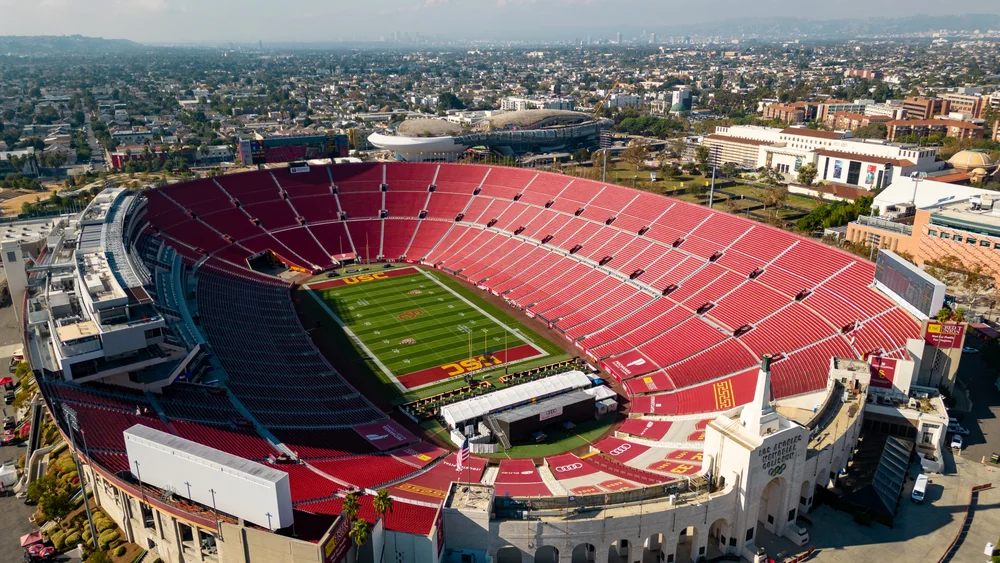
The Los Angeles Memorial Coliseum is a civic monument, Olympic landmark and historic home of USC Trojans football. Opened in 1923 to honor Los Angeles County’s World War I veterans, the 77,500-seat bowl is framed by the east Peristyle and Olympic cauldron. Exposition Park, campus tailgates, the Spirit of Troy, Traveler and Trojan Walk make a game here feel like a journey through the city’s sports history.
Getting to the Los Angeles Memorial Coliseum
Interstates 10 and 110 surround University Park, but Figueroa, Flower, Vermont, Exposition and Jefferson carry heavy event traffic. Left turns into many lots are prohibited on gameday, making the chosen approach more important than distance.
Driving & Parking
- DrivingApproach from the side of campus assigned to the selected structure. Police closures and no-left-turn rules supersede navigation apps near Exposition Park.
- ParkingUSC campus lots and structures open six hours before kickoff and currently charge $50 drive-up, first come, first served. Jefferson and Grand Avenue structures are the principal public options listed by USC.
- ParkingLimited prepaid spaces in Flower and Royal Street structures are offered through USC's parking partner for approximately $60.50. Save the digital credential before entering traffic.
- ParkingExposition Park's Pink, Yellow, Green, Gold and Blue facilities are generally permit inventory. Orange Structure may have limited drive-up football parking; when full, attendants direct vehicles to campus.
- ParkingAccessible spaces are offered first come, first served in campus lots and selected Exposition Park facilities with a placard and identification. Tailgating is prohibited in accessible spaces.
- ParkingPrivate operators sell spaces around Figueroa and Vermont, but USC does not control pricing, security or closing time. Confirm terms before paying.
- ParkingRV and bus inventory requires advance coordination and is extremely limited. Garage height restrictions exclude many oversized vehicles.
Public Transit
- Metro's E Line stops at Expo Park/USC, steps from the museums and a short walk from the Coliseum. It connects Downtown Los Angeles and Santa Monica.
- The J Line busway stops near 37th Street/USC and provides another route from Downtown and South Los Angeles.
- Transfer from Metro's A, B or D lines in Downtown, or use regional rail into Union Station and continue by Metro. Load a TAP card before the event.
- Weekend parking is available at many outlying Metro stations, including some along the E Line, though Culver City and La Cienega/Jefferson fill early.
- After the game, Expo Park/USC station queues can be substantial. Walking one station east or west may help only if event staff permit safe access; otherwise follow platform controls.
Rideshare (Uber/Lyft)
- Official pickup areas are on Vermont Avenue between Exposition Boulevard and 36th Place/Downey Way and near Flower Street at Jefferson Boulevard.
- For arrival, set the approved zone rather than the Coliseum address. Drivers cannot enter the closest Exposition Park roads once closures begin.
- Postgame vehicle access to Exposition Park may be restricted for 45–60 minutes. Walk north through campus or west toward Vermont before requesting a car.
- Metro is usually more predictable than rideshare after a sold-out night game. If using a car, eat near campus and wait for the surge and road controls to ease.
Pregame Festivities
USC gameday begins on the University Park campus, not just at the Coliseum. Alumni Park, McCarthy Quad and school-specific gatherings create a continuous cardinal-and-gold route south through Exposition Park.
Tailgating
- Campus lots open six hours before kickoff, and tailgating is permitted only in designated areas under USC's reservation and space rules. Keep setups clear of buildings, fire lanes and pedestrian routes.
- The central campus lawns host university and alumni events rather than unrestricted vehicle tailgates. Reservations may be required for tents and organized groups.
- Grills, alcohol, generators, amplified sound and tent sizes are regulated by campus policy. Open containers cannot be carried indiscriminately across public streets.
- Trojan Family Game Day ExperienceAlumni Park offers televisions, tables, chairs, food and beverages for purchase in a family-oriented setting.
- Trojan Fan FestSponsor games, merchandise, music and the official radio show provide a public option for fans without a private tailgate invitation.
- Trojan Tailgate ShowThe official pregame broadcast begins at the Peristyle about two hours before kickoff, allowing fans to watch and meet the hosts.
- Tommy's TavernTrojan Athletic Fund members gather inside Olympic Plaza for food and drinks. Because it is inside the scanned perimeter, leaving requires a new ticket to return.
- Leave campus for the Coliseum early. Security lines, the clear-bag check and the walk across Exposition Boulevard can consume the final hour.
Pregame Bars & Restaurants
- USC Village's university-themed pub serves burgers, sandwiches, beer and cocktails in the most convenient polished campus setting.
- Rock & Reilly's USC VillageA large sports bar with screens, Irish-American pub food and an outdoor area. It becomes crowded early on home Saturdays.
- The Figueroa Street restaurant serves handmade dumplings, noodles and Chinese dishes within walking distance of campus and Exposition Park.
- 23rd Street CafeThe neighborhood cafe blends Indian, Mexican and American food, including tikka masala breakfast burritos and quesadillas.
- Inside Mercado La Paloma south of campus, Holbox specializes in Mexican seafood and is a destination-level meal. Lines make it better well before kickoff or on Friday.
- Also in Mercado La Paloma, this Yucatecan counter serves cochinita pibil, panuchos and regional specialties in a casual food-hall setting.
Gameday Traditions
- Trojan WalkThe team reaches the Peristyle entrance roughly two hours 15 minutes before kickoff under the current schedule. Fans line Olympic Plaza to greet players and coaches.
- Spirit of TroyThe USC Trojan Marching Band performs across campus, marches to the Coliseum and supplies “Fight On,” “Tribute to Troy” and “Conquest” throughout the game.
- TravelerThe white horse and Trojan rider meet fans before kickoff and gallop the field after USC scores while the band plays “Conquest.” The tradition began in 1961.
- Tommy Trojan and the drum majorBefore the game, the band performs near the Tommy Trojan statue on campus. The drum major ceremonially stabs the field with a sword during the Coliseum pregame.
- “Fight On” hand signalFans raise two fingers in a V for victory while singing the fight song. The gesture is the universal USC greeting.
- Tunnel captainA Trojan legend or Los Angeles figure leads the team from the tunnel each home game, announced during game week.
- Lighting of the torchAt the start of the fourth quarter, an honored Trojan lights the Olympic cauldron, now paired with videoboard presentation.
- “Tribute to Troy” repetitionThe band plays its driving battle cadence after defensive stops. Opposing fans quickly understand its relentless reputation.
Monuments & Features
- Peristyle and Olympic cauldronThe east-end colonnade and torch form the stadium's civic face. The cauldron was added for the 1932 Olympics and burns for ceremonial moments.
- Memorial Court of HonorBronze plaques in the Peristyle honor athletes, coaches and civic figures connected to the Coliseum's history.
- Olympic Plaza and statuesSculptures and commemorative elements outside the Peristyle recognize the 1932 and 1984 Games and frame Trojan Walk.
- Memorial identityThe venue was commissioned as a living memorial to county residents who served in World War I, a purpose sometimes overshadowed by its sports fame.
- Scholarship Club TowerThe seven-story south-side structure from the 2019 renovation contains suites, club seating, press facilities and the rooftop 1923 Club.
- Legacy WalkwayFan-inscribed pavers at Olympic Plaza create a contemporary layer of USC memory beneath the historic Peristyle.
- Active preservation workConcrete repairs continue through October 2026. Scaffolding and netting may be visible, but USC says normal seating and concessions remain open.
History & Notable Moments
- The Coliseum opened May 1, 1923, and USC played its first football game there that October, defeating Pomona 23-7.
- Architects John and Donald Parkinson designed the original stadium for approximately $800,000. USC became its defining long-term tenant.
- The 1932 Olympics brought the cauldron and worldwide recognition; the 1984 Games returned with memorable opening and closing ceremonies.
- Super Bowl I was played at the Coliseum in 1967, followed by Super Bowl VII in 1973. The Rams, Raiders and Chargers have also used the building.
- The Dodgers played there from 1958 through 1961, using an unusual baseball configuration before Dodger Stadium opened.
- USC's 1967 “Game of the Century” win over UCLA featured O.J. Simpson's famous 64-yard touchdown and helped determine the national championship race.
- The Coliseum became a National Historic Landmark in 1984, recognizing its architectural, Olympic and civic importance.
- DLR Group's $315 million renovation completed in 2019 restored concrete, replaced seating and utilities, improved accessibility and added the Scholarship Club Tower, reducing capacity to 77,500.
- The venue is scheduled to host a third Olympic Games in 2028. That future distinction should not yet be described as completed.
Seating & Sections
The Coliseum is a broad, shallow bowl with sections numbered by tunnel and three principal seating tiers in USC maps. The Scholarship Club Tower occupies the south side, and the Peristyle remains open visually at the east.
- Lower bowlProximity is strongest, but very low sideline rows can be obstructed by personnel. The shallow pitch means heads in front matter more than in a steep modern stadium.
- Upper rowsHigher seats provide a better tactical view and Los Angeles skyline glimpses but can feel distant from the opposite end zone. Escalators serve areas near Tunnels 4, 11 and 19.
- Peristyle endEast-end seating and nearby sections face the tower and videoboard while sitting close to the torch ceremony and Trojan Walk entrance.
- The LegionUSC students occupy a large lower-bowl block and stand throughout the game. Nearby sections receive the full force of the Spirit of Troy.
- Opponent seatingThe 2026 map places visitor inventory in sections 101, 201 and 301. Verify the exact tier because the vertical distance differs substantially.
- Lou Galen Club and Scholarship Club TowerClub seats, suites, loges, Founders areas and the 1923 Club provide chairbacks, indoor spaces and premium service. Inclusions vary by product.
- AccessibilityRenovation added platforms, companion seating and improved routes. Priority gate lanes, modified concessions and in-seat ordering support accessible guests; request exchanges early.
Concessions
Legends operates Coliseum food and beverage, with menus shaped by Los Angeles' Mexican, barbecue, Hawaiian and multicultural food traditions. Most stands are cashless.
- Core stands sell hot dogs, sausages, burgers, chicken, pizza, nachos, pretzels, popcorn, candy, soda and water around the Yard and Concourse levels.
- Current upgrades include a renovated Fight On Grill near Gate 19, expanded portable stands and a new videoboard-supported mobile experience.
- Specialty menus include house-smoked barbecue, street tacos and nachos, Hawaiian-style dishes, loaded fries and rotating Los Angeles concepts.
- Beer and wine are sold to guests 21 and older. Sales end at the close of the third quarter or at least 30 minutes before the event ends.
- Premium clubs and suites offer broader menus and bars. Exact inclusions depend on the ticket and donor product.
- Two factory-sealed water bottles of 17 ounces or less may enter per person. Water fountains and refill points vary by concourse level.
- The historic concourse narrows near major portals. Buy during play or use less crowded stands away from the student and midfield sections.
Bag Policy
- One clear plastic, vinyl or PVC bag no larger than 12 by 6 by 12 inches is permitted, or one one-gallon clear plastic storage bag.
- One small clutch approximately the size of a hand may accompany the clear bag, with or without a strap.
- Medically necessary items may receive an exception after inspection. Contact the Coliseum before gameday for equipment that will not fit an approved bag.
- Backpacks, fanny packs, cinch bags, camera bags, computer bags, luggage, coolers and purses larger than a clutch are prohibited.
- Two factory-sealed plastic water bottles no larger than 17 ounces are allowed per person. Other bottles, cans, alcohol, coolers and containers are prohibited.
- Umbrellas, strollers, poles, large banners, balls, professional cameras with lenses longer than three inches, selfie sticks, tripods, drones, weapons and oversized seat cushions are prohibited.
- All approved bags are inspected. Save the mobile ticket before arrival, enter early and take every needed item because the Coliseum does not permit re-entry.
Upcoming Games
2Stadium Information
Notable Events
Suggested Places
Recommended places to visit near this stadium